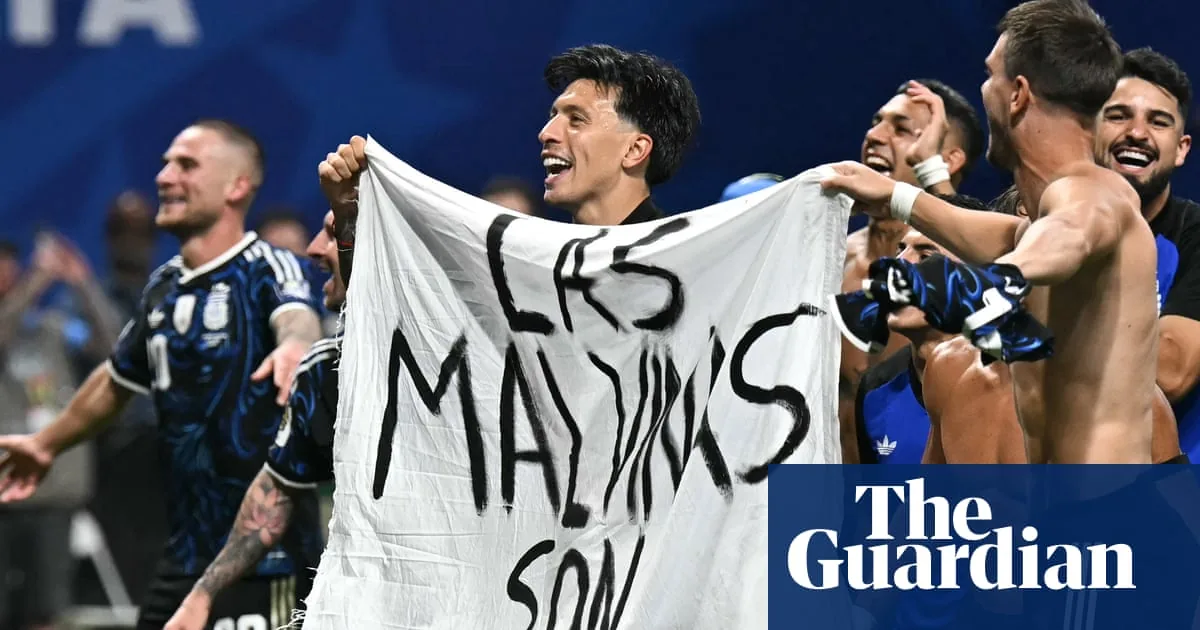
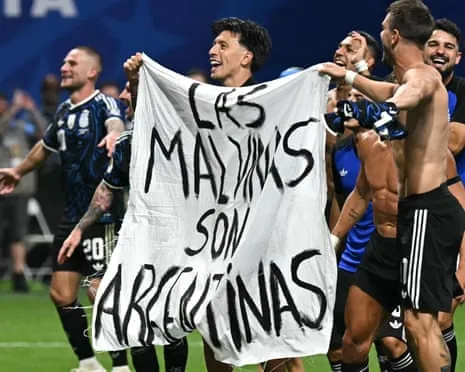
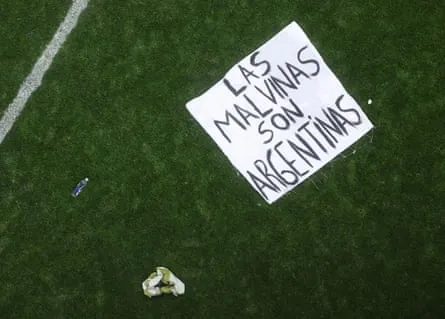
Argentina could face a fine from Fifa after players displayed a banner referencing the Falkland Islands following their World Cup semi-final victory against England in Atlanta. The banner, which read “Las Malvinas son Argentinas” (The Falklands are Argentine), was shown after Argentina secured a 2-1 win, booking their place in the final against Spain.
The display comes amidst a long-standing sovereignty dispute between Britain and Argentina over the Falkland Islands, a British overseas territory. A conflict over the islands occurred from April to June 1982, resulting in the deaths of 655 Argentine and 255 British servicemen, along with three island residents.
This is not the first instance of such a display by Argentina’s national team. In 2014, the Argentine Football Association was fined £20,000 by Fifa for a similar banner shown before a friendly match against Slovenia. Fifa’s regulations prohibit political actions and team misconduct, as well as banners or other paraphernalia deemed political, offensive, or discriminatory within stadiums.
Banner Display and Reactions
After the semi-final match, players Lisandro Martínez and Giovani Lo Celso were seen holding the banner. The origin of the banner within the stadium was not immediately clear. Argentina’s vice-president, Victoria Villarruel, commented on social media after the victory, stating that the Falklands are Argentine and suggesting that while banners might be banned from stadiums, the sentiment remains strong.
This sentiment was echoed in chants by some Argentina players after their win against England in the semi-final, which referenced the Falklands, Diego Maradona, and Lionel Messi.
However, before the semi-final, Argentina manager Lionel Scaloni had expressed a desire to keep football and politics separate. He stated that the match was a football game and that mixing the two, especially out of respect for past events, was inappropriate. Scaloni described the 1982 conflict as a “very sad period” and emphasised that while those who died are remembered, a football match should not be confused with such historical events.
Security Measures and Fifa Regulations
The semi-final match itself was held under heightened security measures due to the historical tensions between the two nations. Argentina’s security minister, Alejandra Monteoliva, had confirmed that 1,600 officers would be present to ensure a peaceful celebration and that items with provocative political or racial messages were prohibited.
Rodrigo De Paul, an Argentina midfielder, acknowledged the broader significance of the game, stating that it “transcends” and brings back memories. He mentioned singing songs about “Malvinas heroes” to remember them, but also stressed the importance of understanding it as a football match, with discussions about the Falklands belonging elsewhere. De Paul referred to the past conflict as an “atrocity” and highlighted the team’s focus on winning the match to reach the final.
Fifa’s stadium code of conduct explicitly bans “banners, flags, flyers, apparel and other paraphernalia that are of a political, offensive, and/or discriminatory nature” inside stadiums. The governing body did not immediately provide a comment on the incident.
Argentina will now play Spain in the World Cup final in New Jersey on Sunday.
Read Also
Source: bbc.co.uk