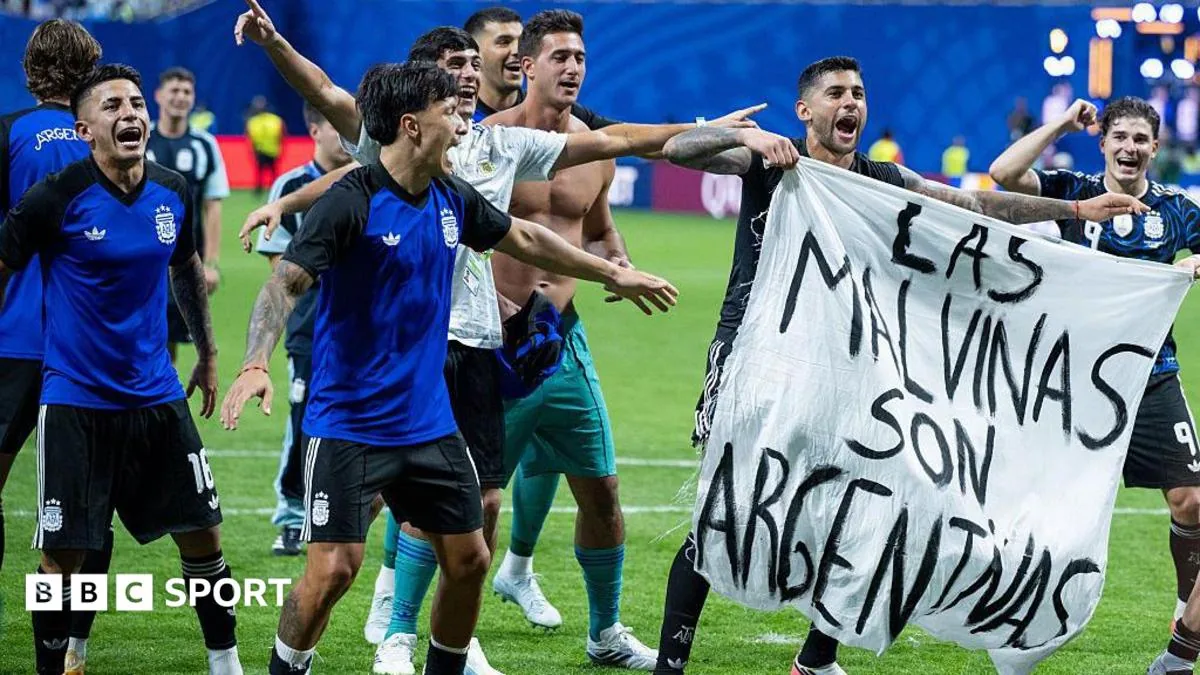
Argentina’s World Cup semi-final victory and banner display
Fifa is currently evaluating match reports following an incident where Argentina players displayed a banner supporting their country’s claim to the Falkland Islands. This occurred after their World Cup semi-final win against England. The defending world champions secured a dramatic late comeback in Atlanta, scoring two goals to defeat Thomas Tuchel’s side 2-1, thereby booking their place in Sunday’s final against Spain.
Following the final whistle, Argentina players held up a banner that read “Las Malvinas son Argentinas,” which translates to “The Falklands are Argentine.” The Falklands, a British overseas territory located in the south-west Atlantic Ocean, remain a point of contention in a sovereignty dispute between the UK and Argentina.
A Fifa spokesperson confirmed that the independent disciplinary committee is assessing the match reports and relevant circumstances. This assessment will determine potential further steps based on the Fifa disciplinary code. In 2014, Argentina’s football association was fined for displaying a similar banner before a friendly match against Slovenia, with Fifa stating at the time that the gesture breached rules regarding political action and team misconduct.
The UK government has commented on the situation, with the prime minister’s official spokesperson stating, “The World Cup might not be ours, but the Falkland Islands definitely are. Our commitment to the Falklands will never waver.” The spokesperson also indicated that any potential action against the Argentina players is a matter for Fifa, while echoing calls for an investigation. The government of the Falkland Islands expressed disappointment regarding the banner and hopes Fifa will “sanction all behaviour of this nature in line with its own rules.”
Political reactions and historical context
Argentina’s President Javier Milei reportedly described the players’ action as “understandable” and “valid.” However, he also clarified that “the things that happen on the pitch are not part of diplomacy,” in comments made to Radio El Observador. He further stated, “Indeed, the Malvinas are Argentine, we are going to recover them, and we’re going to do it in the diplomatic field, by acting intelligently.”
The sovereignty dispute dates back to 1982 when Argentina, then under a military junta led by General Leopoldo Galtieri, invaded the islands, which are situated 300 miles off Argentina’s east coast. The conflict, which lasted for 74 days between April and June 1982, resulted in the deaths of 649 Argentine and 255 British servicemen, along with three islanders.
In 2013, the people of the Falkland Islands held a referendum, with an overwhelming majority voting in favour of remaining a UK overseas territory. Out of 1,517 votes cast, 1,513 were in favour, with only three votes against, on a turnout exceeding 90%.
Liberal Democrat leader Ed Davey has called for the Argentina players involved in holding the banner to be suspended for Sunday’s final against Spain. He cited the precedent of Uefa’s ban of Spain players Alvaro Morata and Rodri for one game after they chanted “Gibraltar is Spanish” during their Euro 2024 celebrations. Gibraltar, an enclave at Spain’s southern tip, has been under British rule since the 18th century, with Spain long advocating for its return.
There is also a precedent for Fifa banning a player for a similar political message. After the 2012 Olympic Games bronze medal match, South Korea midfielder Park Jong-woo displayed a sign in Korean that read “Dokdo is our territory.” Dokdo, also known as Liancourt Rocks, is a group of inlets administered by South Korea but claimed by Japan. Park was subsequently charged by Fifa and received a two-match suspension, which meant he missed two World Cup qualifiers.
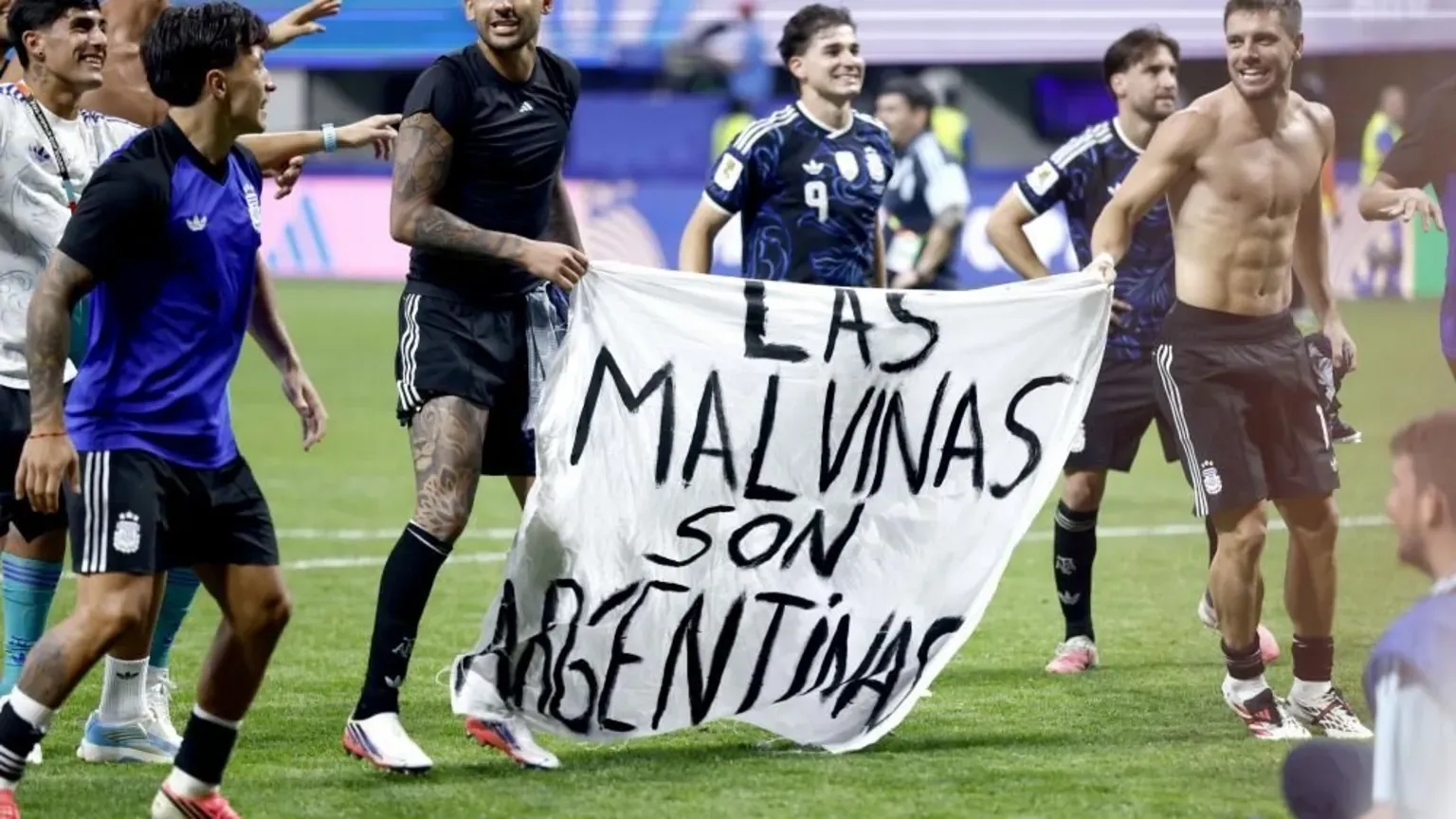
Ongoing discussions and future implications
Peter Kyle, the business and trade secretary, emphasised the importance of keeping politics out of the World Cup and urged Fifa to investigate. He contrasted the professionalism and dignity shown by the England team with the actions of the Argentine team. Kemi Badenoch, the leader of the Conservative Party, echoed these sentiments, stating that Fifa “absolutely should investigate.”
Argentina midfielder Leandro Paredes commented after the match that the Falklands War was a “sad part of our history” and that the game was “not just a football match” for his nation. Prior to the semi-final, Argentina manager Lionel Scaloni had stated his intention not to mix football and politics, acknowledging the historical sadness but emphasising that it was a football match.
The vice-president of Argentina, Victoria Villarruel, posted on X after the victory that “it wasn’t just another match,” alongside a video that appeared to show Argentine soldiers. She further posted, “The Falklands are Argentine. They banned bringing them to the stadium and forgot that we carry them in our blood and our hearts.” This follows previous instances where Argentina players sang chants referencing the Falklands and Argentina greats Maradona and Lionel Messi after their 3-2 win over Egypt in the last 16.
The Fifa disciplinary committee’s assessment is a standard procedure that will determine any potential further steps based on the Fifa disciplinary code.
Read Also
- Argentina could face disciplinary action after displaying Falklands banner following England win
- Atlanta: England manager Thomas Tuchel to remain until Euro 2028 despite World Cup semi-final loss
- England's World Cup exit to Argentina prompts scrutiny of Tuchel's tactics
- Marcus Rashford's Manchester United Future Uncertain as Exit Clause Expires
Source: bbc.co.uk