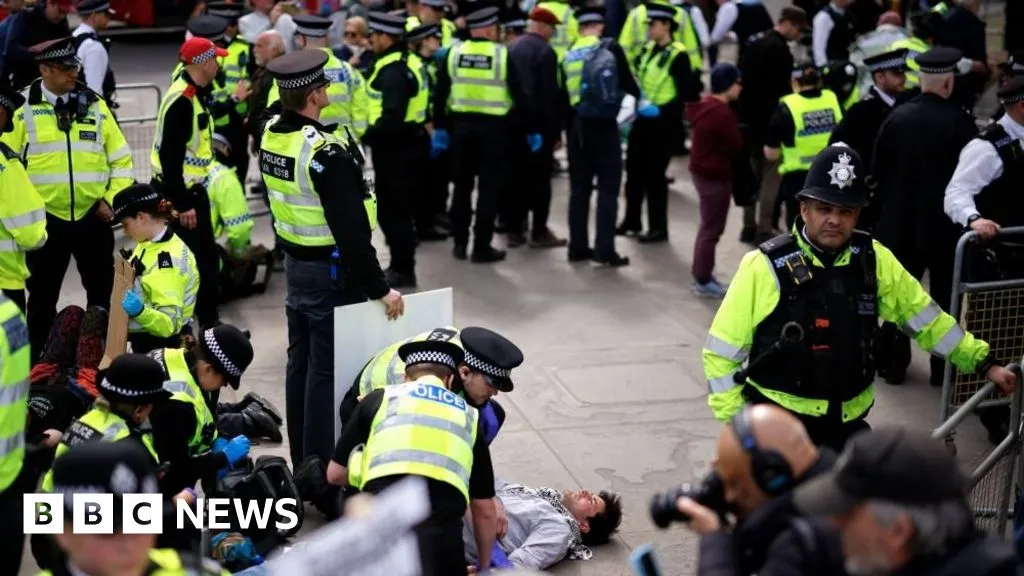
In a significant escalation of tensions between protest groups and law enforcement, police arrested 212 individuals during a mass vigil in Trafalgar Square on April 11, 2026. This event drew an estimated 1,500 participants, who gathered to express their dissent against the UK government’s recent actions regarding Palestine Action, an organization that has been at the center of a contentious legal battle.
Prior to this development, the UK government had classified Palestine Action as a terrorist organization in July 2025, placing it alongside notorious groups such as al-Qaeda and Hezbollah. This designation sparked widespread outrage and protests, culminating in the High Court’s ruling on February 13, 2026, which deemed the government’s proscription unlawful. As the UK government prepares to appeal this ruling on April 28 and 29, the atmosphere surrounding the protests has become increasingly charged.
The arrests made during the vigil reflect a broader crackdown on dissent, with ages of those detained ranging from 27 to 82. One demonstrator voiced concerns about the implications of these actions, stating, “I think Britain has now descended into a non-democratic situation and I think that is very dangerous [for] free speech.” This sentiment underscores the growing anxiety among activists regarding their rights to protest and express their views.
In a parallel development, Irish police have also intensified their enforcement efforts against fuel-cost protesters, with Commissioner of An Garda Siochana emphasizing that illegal activities by these groups pose a threat to the state. The operation to clear a blockade at the Whitegate oil refinery was completed in approximately an hour, demonstrating the authorities’ commitment to maintaining order amidst rising tensions over fuel shortages. Reports indicate that around 600 filling stations across the Republic of Ireland have run dry, exacerbating public frustration.
The immediate effects of the arrests and police actions have reverberated through both the protest community and law enforcement agencies. Justin Kelly, a spokesperson for the police, declared, “We will not tolerate this any longer,” indicating a firm stance against what authorities perceive as unlawful gatherings. Meanwhile, Qesser Zuhrah, a prominent figure within the protest movement, criticized the Metropolitan Police, stating, “It just shows that the Met police, they don’t serve us, they don’t protect us, they work only to reinforce what the government wants.”
Experts and activists alike are now grappling with the implications of these developments. The High Court’s ruling against the government’s classification of Palestine Action has raised questions about the balance between national security and civil liberties. As the UK government prepares for its appeal, the outcome could set a significant precedent for future protests and the treatment of dissenting voices.
As the situation unfolds, the urgency of the protests and the government’s response will likely continue to shape public discourse around policing, free speech, and the rights of citizens to assemble. With the appeal date approaching, both sides are bracing for a pivotal moment that could redefine the landscape of protest in the UK.