Glasgow’s Role in the Commonwealth Games’ Future
Glasgow stepped in to host the Commonwealth Games at short notice after Victoria withdrew due to cost concerns. This intervention is seen as crucial in preventing the event’s extinction. The city’s approach to hosting, which involved a scaled-down version of the Games, has been highlighted as a potential blueprint for future hosts. This model prioritises affordability and the use of existing facilities, moving away from the previous long list of demands for host cities.
The Commonwealth Sport president, Dr Donald Rukare, acknowledged Glasgow’s role, stating that the city acted as a bridge to the movement’s future. The event was characterised by bravery, courage, friendship, and innovation. The shift in hosting philosophy means that future Games are likely to be designed around what a host can realistically afford and deliver, rather than imposing rigid targets.
This new approach, termed “Games Reset” by Commonwealth Sport, encourages hosts to utilise existing infrastructure and offers greater flexibility in shaping the sports programme. It also maintains the inclusion of para sports events within the same Games and aims for an equal balance of events for women and men. The budget for Glasgow’s Games was significantly lower than previous editions, with early projections indicating a spend of approximately £162.6 million, compared to Birmingham 2022’s £778 million.
Team Scotland’s Performance in Glasgow
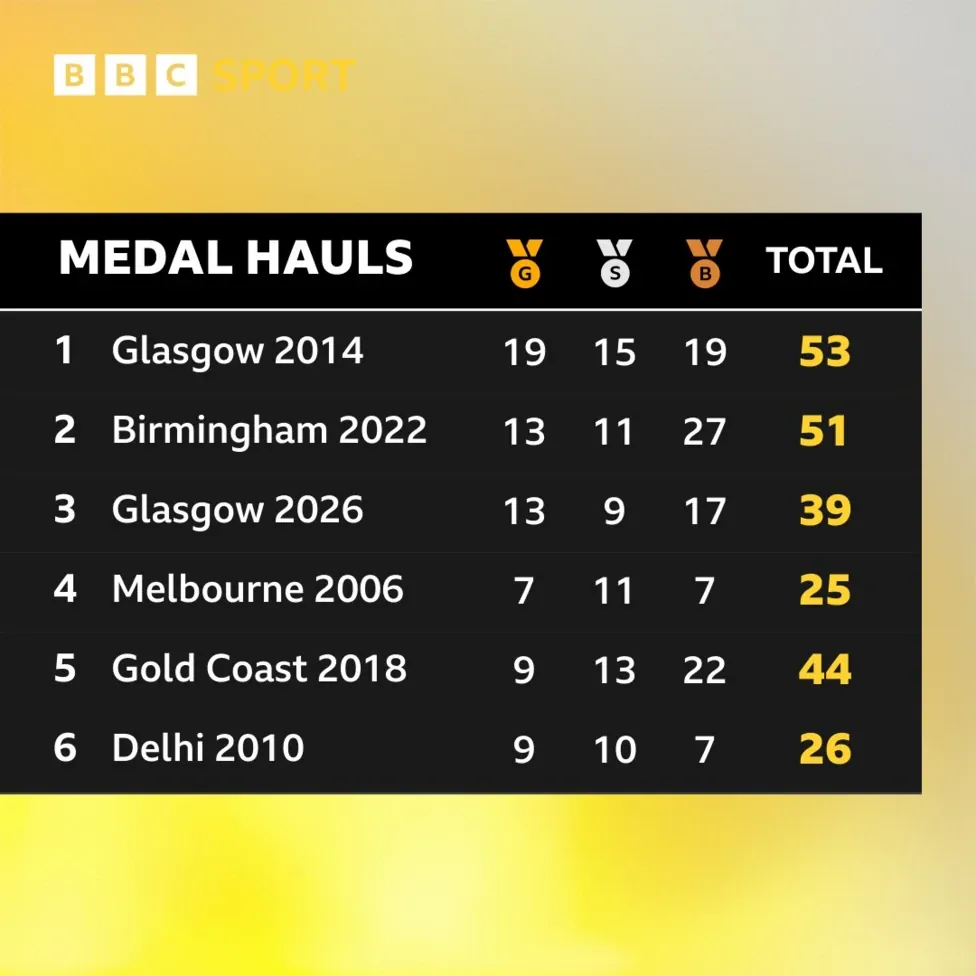
Team Scotland concluded the Glasgow Games with 39 medals in total, including 13 golds, placing them fifth in the medal table. This performance marks Scotland’s third-best ever in terms of medals won at a Commonwealth Games. The medal count included nine silver and 17 bronze medals. This result is one place higher than their finish in Birmingham four years prior, with the same number of gold medals.
The Games saw 177 athletes representing Team Scotland, a smaller contingent compared to the 313 athletes at Glasgow 2014. Despite fewer athletes and a streamlined sports programme offering 215 gold medals, compared to 283 in Birmingham and 261 in 2014, Scotland’s medal-per-competitor ratio improved. The team achieved a medal for every 4.54 competitors, an improvement from 5.30 four years ago.
Elinor Middlemiss, Team Scotland’s chef de mission, expressed pride in the team’s achievements, highlighting the numerous medals, historic firsts, individual and team records, and lasting memories created. The medals were distributed across various sports, genders, and abilities. Only two of the ten disciplines, netball and Para-powerlifting, did not yield medals for Scotland.
Athletics recorded its second-biggest haul in 44 years, and gymnastics celebrated a first-ever men’s all-around gold. The team also achieved an all-time best of 14 Para-sport medals. A first team sport medal was secured in 3×3 basketball, followed by a second on the same day. Additionally, Scotland earned its first-ever podium finish in women’s boxing. Of the 39 medals, 20 were claimed by men, 17 by women, and two by mixed teams, with 43% of the medals going to female athletes, consistent with the Birmingham Games.
Key Scottish Medallists and Future Outlook
Duncan Scott added two medals to his collection, further solidifying his position as Scotland’s most decorated Games athlete with 14 medals in total. However, Neil Fachie surpassed him in gold medals, claiming two golds in Para-cycling to reach a total of seven. Angharad Evans was a standout performer, securing two individual golds and relay silver and bronze in swimming.
Other multiple medallists included swimmers Keanna MacInnes (three silver, one bronze), Katie Shanahan (two silver), and Stephen Clegg (gold and silver). Para-athlete Melanie Woods won two golds on the track, and closing ceremony flagbearer Reuben Ward earned gold and silver in gymnastics. At the velodrome, Erin Boothman claimed double cycling bronze, and Fin Graham secured silver and bronze.
Looking ahead, India is set to host the centenary Games in 2030 in Amdavad, with plans for 15 to 17 sports, a significant increase from Glasgow’s ten. The sports programme for 2030 is expected to be announced early next year at Commonwealth Sport’s annual general meeting. The Games in India are anticipated to be larger than Glasgow’s but are unlikely to revert to the previous one-size-fits-all model. The next Games in India will feature 50 per cent more sports than Glasgow.
The Commonwealth Games movement is exploring future hosts, with four private expressions of interest for 2034. Nigeria has expressed interest in becoming the first African host, and New Zealand is considering a lower-cost approach to hosting for the first time since 1990. Canada has not hosted since 1994. The shift in hosting strategy, exemplified by Glasgow, aims to ensure the long-term viability of the Commonwealth Games.
Source: bbc.com